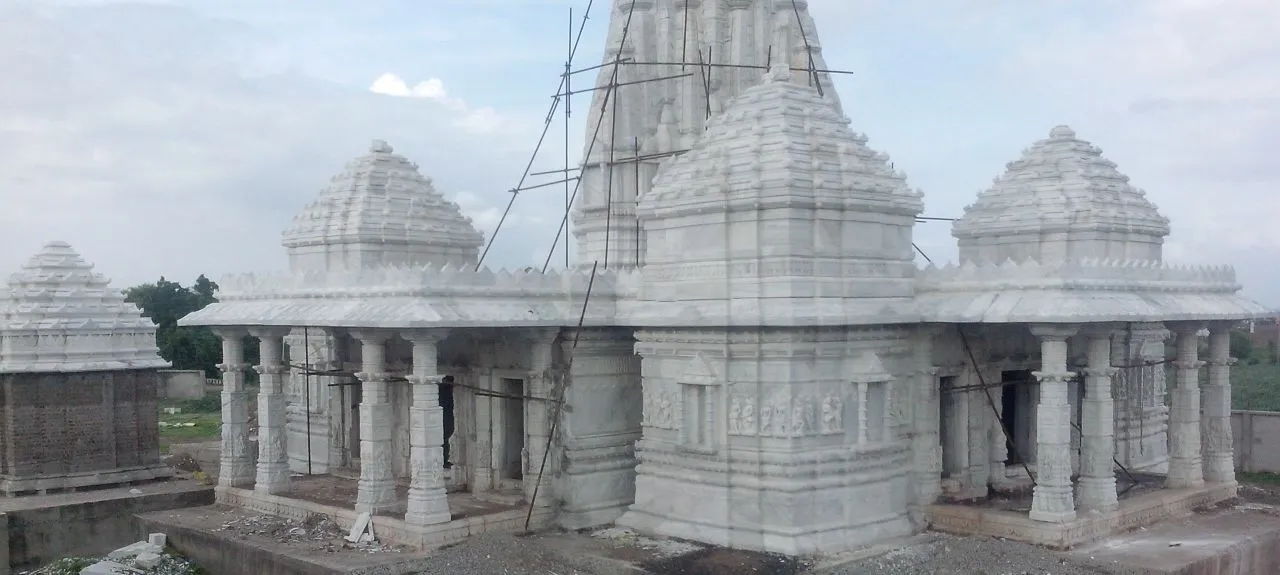
Marble has been the sacred stone of Indian temple architecture for more than two thousand years. From the Dilwara Temples at Mount Abu to the Akshardham complex in Delhi, white marble carries a spiritual weight that no other material replicates. This guide is written for temple trusts, donors, project architects, and committees undertaking a new mandir — covering stone selection, specification, carving standards, and supplier due diligence.
Why White Marble is the Preferred Stone for Hindu Temples
The use of white marble in temple construction is not merely aesthetic — it is rooted in shastric tradition and practical theology. In Vastu Shastra and the Manasara (the ancient Sanskrit text on architecture), white stone (sweta shila) is described as the most auspicious material for shrines dedicated to Vishnu, Shiva, and other deities of light and purity.
Practically, white marble's properties suit a temple environment particularly well. It stays cool inside the sanctum regardless of outdoor temperature — a meaningful comfort for bare-footed worshippers. It is easy to clean with plain water, important for daily ablutions and abhishek. And it endures centuries of use without structural degradation, provided it is correctly specified and installed.
Rajasthan — and specifically the belt stretching from Rajsamand to Udaipur — is the primary source of high-quality white marble for Indian temple construction. The stone from this region has a crystalline structure, high whiteness index, and consistent grain that makes it ideal for both structural work and detailed carving.
Understanding the Parts of a Temple and Their Stone Requirements
A traditional Hindu temple comprises several distinct architectural elements, each with different structural demands and, therefore, different stone specifications.
Garbhagriha (Sanctum Sanctorum)
Function: The innermost shrine housing the deity.
Stone spec: Highest grade, maximum whiteness. Thick flooring (20mm+), fine-grained for carving. No visible staining or grain irregularities acceptable.
Shikhara / Vimana (Tower)
Function: The crowning spire above the sanctum.
Stone spec: Dense, low-porosity stone. Structural load-bearing. Custom-cut blocks. Weathering resistance critical.
Mandapa (Pillared Hall)
Function: Assembly hall for worshippers.
Stone spec: Uniform appearance across large floor area. High-traffic durability. Polished or honed finish depending on the trust's preference.
Pradakshina Patha (Circumambulation Path)
Function: The path walked around the sanctum.
Stone spec: Non-slip surface essential — honed or sandblasted. Outdoor-grade where exposed. Width typically 1.5–3m depending on temple scale.
Pillars and Toranas
Function: Structural and decorative columns, entrance arches.
Stone spec: Single-piece blocks preferred for pillars up to 2m. Fine grain for carving. Must be free of internal fractures.
Exterior Cladding
Function: Outer wall surfaces exposed to weather.
Stone spec: Medium-density, weather-resistant. Thermal movement must be accounted for in jointing. Can accept slightly lower whiteness grade than interior work.
Marble Grades for Temple Work — What to Specify
Not all white marble is equal, and this distinction matters enormously in temple construction where the stone will be viewed at close range and in strong light for generations. At Vikas Marmo we classify our temple-grade stone against the following parameters:
| Parameter | Temple Grade (minimum) | Standard Grade |
|---|---|---|
| Whiteness Index (ASTM) | 85+ | 70–84 |
| Water absorption (%) | Less than 0.4% | 0.4–0.8% |
| Compressive strength | 120 MPa minimum | 80–120 MPa |
| Surface finish | Mirror polish, zero pitting | Standard polish acceptable |
| Visible veining | Light grey, no black or brown | Grey to medium density |
| Block size (for pillars) | Single block up to 3m | Standard slab dimensions |
| Lot consistency | Full project from single quarry lot | Standard lot tolerance |
From our 45 years of temple projects: The single most common regret we hear from temple trusts is accepting a lower whiteness grade to reduce cost, only to find that the stone yellows unevenly within five to ten years — especially in humid climates. For a project that will last centuries, the grade of stone is not the place to economise.
Temple Marble Carving — Silpashastra Traditions and Modern Practice
Traditional Hindu temple sculpture follows the Silpashastra — the ancient canonical texts that codify the proportions, iconography, and symbolic language of every deity, vahana, and architectural element. Modern temple work must balance these traditions with practical considerations of time, budget, and available craftsmen.
The craftsmen of Rajasthan
The primary centres of marble carving in Rajasthan are Jaipur and Kishangarh, where families of silpis (stone craftsmen) have worked for generations. The finest temple work is still done by hand, using traditional chisels and knowledge passed through apprenticeship. For high-profile temple projects, it is worth specifying hand-carved work for the primary deity niche, toranas, and shikhara details, even if machine-assisted carving is used for repetitive decorative elements.
Machine carving and CNC work
Modern CNC machines can replicate complex designs in marble with a precision and repeatability that hand carving cannot match for mass production. They are suitable for: repetitive border patterns, large-area decorative panels, inscriptions and text, and elements where dimensional consistency is critical (like stepped platforms). CNC work is not appropriate for primary deity sculptures, where the spiritual energy is considered to reside in the craftsman's intention and skill.
Quantities and Planning — A Practical Framework
Temple projects are among the most complex stone procurement exercises because they involve multiple component types, precise custom cutting, long project timelines, and often non-negotiable completion dates tied to muhurtas (auspicious dates for consecration ceremonies).
- Engage your marble supplier at the design stage. Too many trusts finalise architectural drawings and then discover that the specified dimensions require non-standard block sizes or exceed what is available from a single quarry lot. A supplier involved early can flag constraints before they become expensive problems.
- Order a 20–25% buffer for carved elements. Carving generates significant waste, and cracking during carving is an occupational reality. Never order the exact calculated quantity for ornamental pieces.
- Plan for phased delivery with storage. Large temple projects may take 3–8 years. Stone ordered at the outset must be stored correctly to avoid staining and surface degradation. Ask your supplier about covered storage options at the factory.
- Commission sample carvings before full production. For any carved element, request a sample piece approved by the project architect and silpi master before full production begins. Changes to design after mass production has started are costly.
- Get written confirmation of quarry lot reservation. For large projects, ask your supplier to formally reserve your quarry lot in writing. Otherwise, your stone may be sold to another buyer during a long project timeline.
Vastu and Shastric Considerations for Stone Selection
While modern engineers and architects focus on compressive strength and water absorption, the Vastu and Agama traditions that govern Hindu temple construction include specific guidance on stone selection that a traditional patron or temple trust may wish to consider alongside technical specifications.
- Living stone (jiva shila): Stone that produces a clear ring when struck, and is free of cracks, holes, or discolouration is considered jiva shila — spiritually alive. A stone that produces a dull sound is considered mruta shila (dead stone) and should be avoided for the garbhagriha.
- Direction of grain: Some shastric texts recommend that the grain of floor stone in the sanctum runs east-west, aligned with the orientation of the deity.
- White and pure: Stones with red, yellow, or black pigmentation are traditionally not used for Vaishnava and Shaiva shrines. Light grey veining in white marble is generally acceptable; heavy dark veining is not.
- Single-origin stone: There is a traditional preference for all stone in a single shrine to come from the same quarry or mountain, understood as maintaining the energetic unity of the space.
How Vikas Marmo Supports Temple Projects
We have supplied white marble for temple projects across Rajasthan, Gujarat, Madhya Pradesh, and for the diaspora communities building mandirs in the UAE and abroad. Our temple project support includes: free site visits and stone selection guidance, quarry lot reservation for long-duration projects, custom block cutting and pre-finishing at our Kelwa factory, liaison with carving workshops in Jaipur and Kishangarh, and export documentation for overseas temple projects.
Planning a Temple Project?
We have been supplying sacred stone since 1980. Tell us about your mandir — location, scale, timeline — and we will prepare a detailed stone specification and quotation.
Discuss Your Temple Project ›